
Hair Transplant Terminology Guide
65 essential terms covering hair transplant techniques, instruments, sterilization, and procurement, clearly defined for clinics and distributors.
Techniques
How the main hair restoration methods differ, and which instruments each one calls for.
- FUE (Follicular Unit Extraction)
- Harvesting individual follicular units directly from the donor area with a small circular punch, rather than removing a strip of scalp. Today it is the most widely used technique. See our FUE instrument guide.
- FUT (Follicular Unit Transplantation)
- The older strip technique: a strip of donor scalp is excised and dissected into follicular units under magnification, leaving a linear donor scar.
- DHI (Direct Hair Implantation)
- A placement method in which an implanter pen opens the channel and places the graft in one motion, instead of premade incisions and forceps placement. Extraction is still performed with an FUE punch.
- Sapphire FUE
- FUE in which the recipient channels are opened with sapphire blades instead of steel blades. The extraction stage is unchanged; the name refers to the incision stage.
- Micro FUE
- A clinic marketing name for FUE performed with small-diameter punches, usually around 0.9 mm and under. It is not a separate technique or device class. See what micro FUE really means.
- Long Hair FUE (No-Shave FUE)
- FUE performed without shaving the donor area: units are excised with the hair shaft intact, so the hair direction stays visible at placement. It uses a punch designed for long hair. See how no-shave extraction works.
- Manual vs motorized FUE
- Whether punch rotation is driven by the surgeon's fingers (manual holder, direct feedback) or by a powered handpiece at a set speed. The same punch families serve both. See our comparison.
- Body & beard hair transplant (BHT)
- Harvesting donor units from the beard or body when the scalp donor supply is limited. Beard and body follicles differ in caliber and depth, so punch diameter and working length are selected per region.
- Dense packing
- Placing grafts close together in the recipient area. It calls for fine, consistent incisions, which is one of the main reasons thin recipient blades and small-bore implanter needles exist.
The FUE punch
The anatomy of the harvesting instrument itself.
- FUE punch
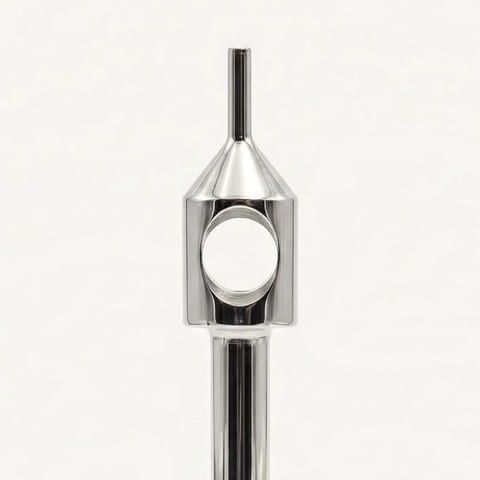
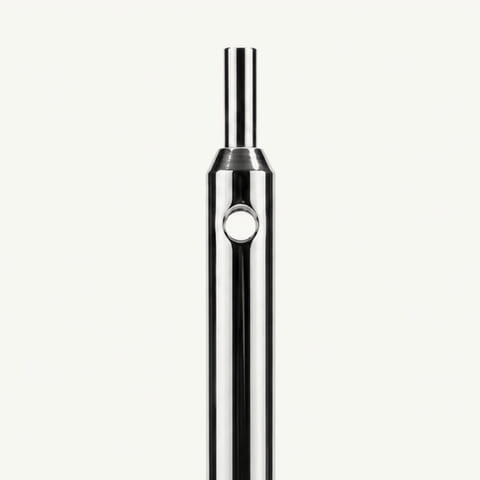
- A thin-walled cylindrical cutting instrument that scores the skin around a follicular unit so it can be freed and lifted. Specified by diameter and working length, in sharp, serrated or trumpet geometries.
- Blunt (dull) punch
- A punch with a deliberately non-cutting rim profile that dissects around the unit after a shallow initial score. It is designed to deflect follicles at depth rather than cut them.
- Hybrid punch
- Any edge geometry that combines a sharp entry with a blunting or flaring profile deeper in the cut: sharp where the skin is scored, gentler where the follicles sit.
- Serrated punch
- A punch whose rim carries fine teeth. Outer micro-serration is designed to seat on the skin at first contact; internal serration is designed to separate tissue planes after the initial score.
- Trumpet (flared) punch
- A punch whose tip flares outward like a trumpet, designed to steer the cutting edge away from the follicle as depth increases. It is often preferred on fibrotic or scarred donor tissue.
- Punch diameter (Ø)
- The size a punch is specified by, typically in tenths of a millimetre (e.g. Ø 0.80 mm); Garry punches are specified by their inner diameter. It governs graft fit, donor footprint and harvest feel. See the size selection guide.
- Wall thickness
- The difference between a punch's outer and inner diameter. Thinner walls displace less tissue for a given bore; the trade-off is edge durability.
- Working length
- How deep the punch's cutting portion reaches, commonly 3.0-4.0 mm, matched to follicle depth for the patient and donor region.
- Depth control (depth stop)
- Any mechanical limit - on the punch, the holder or the handpiece - that caps insertion depth so the cutting edge stops short of the follicle bulbs.
Extraction & donor
What is harvested, from where, and what can go wrong.
- Follicular unit
- The naturally occurring bundle of 1 to 4 hairs (with its supporting tissue) that grows together in the scalp. It is the unit that FUE extracts and transplants intact.
- Graft
- A harvested follicular unit ready for placement. Graft caliber (thickness) is what punch diameter and implanter needle bore are sized against.
- Graft caliber
- The measured thickness of a graft, driven by how many hairs the unit contains and the tissue cuff around them. Punch bore and implanter needle sizes are matched against it.
- Donor area
- The region from which follicular units are harvested, typically the back and sides of the scalp.
- Tumescence
- Infiltrating the donor area with fluid to firm the skin and lift follicular units toward the surface, giving the punch a more consistent cutting plane.
- Extraction forceps
- Fine-tipped forceps used to lift a scored follicular unit free of the donor. Tip quality matters: grafts are held by their tissue cuff, never squeezed at the bulb.
- Transection
- Accidental cutting of a follicle during extraction, which can render the graft unusable. Minimising transection is a core design goal of punch geometry and a core skill of FUE technique.
- Overharvesting
- Taking more follicular units from a donor region than it can visually afford, leaving diffuse thinning. Managed by spacing extractions and respecting per-zone limits.
Incision & placement
Opening the recipient sites and seating the grafts.
- Recipient site
- The area receiving grafts. In slit-based protocols, channels are opened here with steel or sapphire blades before placement.
- Premade incisions
- The 2-stage placement protocol: channels are opened first with steel or sapphire blades, then grafts are seated into them with forceps or a dull implanter. It is the alternative to one-motion DHI.
- Lateral vs sagittal slits
- The orientation of recipient incisions relative to hair direction: lateral (coronal) slits sit perpendicular to growth and help control exit angle; sagittal slits run parallel. Blade width choice follows the orientation.
- Sapphire blade
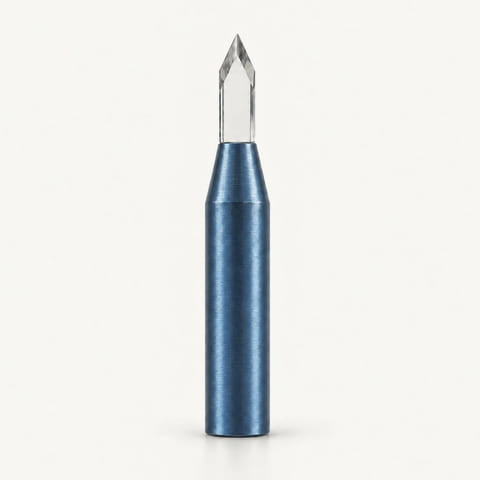
- A recipient-site blade ground from sapphire crystal, designed to hold a fine, consistent edge through long sessions. See our sapphire blades and the sapphire vs steel comparison.
- Slit blade
- A steel recipient-site blade, often trimmed to a case-specific width in a cut-to-width holder. It is the economical standard for channel opening.
- Custom-cut blade
- A recipient blade trimmed chairside to a case-specific width from blank stock, then mounted in a cut-to-width holder. This is the traditional way to match incision width to graft caliber.
- Blade holder
- The handle a blade mounts into, controlling exposed depth and grip.
- Implanter pen (DHI pen)
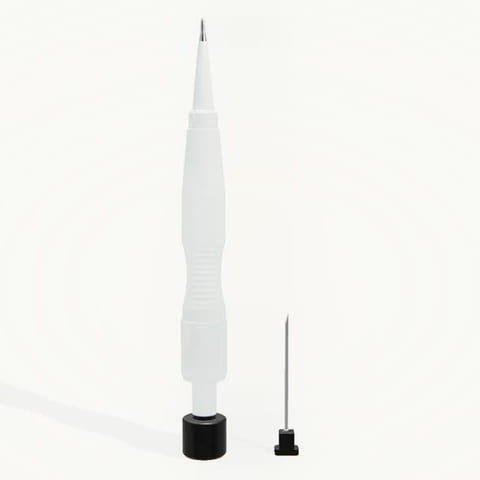
- A spring-loaded pen with a hollow needle that opens the channel and places the graft in one motion. "DHI pen" is another name for the same instrument class. See the DHI implanter pen range.
- Implanter needle
- The consumable hollow needle through which an implanter pen places grafts, with its bore sized to graft caliber. See needle sizing.
- Exposed needle length
- The needle length protruding from an implanter pen's seat, which sets implantation depth. A repeatable needle seat keeps this calibrated across needle changes.
- Placement forceps
- Angled fine forceps used to seat grafts into premade incisions, holding the graft by its tissue cuff to keep pressure off the follicles.
Materials & manufacturing
What the instruments are made of, and why it matters.
- Martensitic stainless steel
- The hardenable family of stainless steels (AISI 420/440 classes) used for cutting instruments. Heat treatment allows these steels to hold a fine edge.
- Sapphire crystal
- The material of the sapphire blade's cutting tip, used for recipient channel opening in Sapphire FUE.
- Edge retention
- How long a cutting edge keeps its ground geometry in use. It depends on material hardness, edge angle and load, and it is the property behind steel-grade and sapphire choices.
- Passivation
- The chromium-oxide surface layer that gives stainless steel its corrosion resistance. See passivation, explained.
- Corrosion & pitting
- Localized attack on stainless steel, usually from chloride exposure (saline left to dry, aggressive chemistry) or a damaged passive layer. Prevented by prompt rinsing and correct reprocessing.
- Laser marking
- A permanent, additive-free method of applying sizes and order codes to instruments. It survives repeated sterilization without creating corrosion-prone recesses.
Sterilization & care
Keeping reusable instruments safe and in specification.
- Autoclave
- A pressurized steam sterilizer, the standard means of sterilizing reusable surgical instruments. Cycles are defined by temperature, exposure time and air-removal method.
- Prevacuum (Class B) cycle
- A steam sterilization cycle that actively removes air before steam is injected. It is the right choice for lumened instruments. See gravity or prevacuum.
- Ultrasonic cleaning
- A pre-sterilization cleaning stage that uses cavitation in a detergent bath to strip debris from lumens, serrations and joints that brushes can't reach reliably.
- Reprocessing
- The full cycle a reusable instrument goes through between uses: point-of-use rinse, cleaning, inspection, packaging and sterilization, with each step following the manufacturer's IFU.
- Single-use vs reusable
- A designation set by the manufacturer and stated in the IFU, based on whether the device can be cleaned and sterilized while remaining within specification. It is not a judgement call made chairside.
- Sterilization container
- A rigid, filtered or valved container, used instead of wrap, in which instruments are sterilized and stored. It is sized for steam penetration in the standard 134 °C prevacuum cycle.
- IFU (Instructions for Use)
- The manufacturer's document governing how a device is used, cleaned, sterilized and (where applicable) reused. Reprocessing questions are answered by the IFU, not rules of thumb.
Ordering & supply
The vocabulary of B2B ordering and international supply.
- Order code (SKU)
- The unique code that identifies one exact configuration (family, diameter, working length, fitting). Ordering by code rather than by description makes it easier to reorder the same item.
- EC Declaration of Conformity
- The document in which a manufacturer declares, on its own responsibility, that a product meets the EU legislation applying to it. It accompanies CE-marked devices and names the applicable regulation.
- MDR (EU 2017/745)
- The EU Medical Device Regulation, the legal framework governing medical devices placed on the EU market. It covers classification, conformity assessment, vigilance and post-market surveillance.
- UDI (Unique Device Identification)
- The system of machine-readable device identifiers that links a physical product to its record. Each UDI combines a device identifier for the model with a production identifier for the specific run the product came from.
- MOQ (minimum order quantity)
- The smallest quantity a manufacturer produces or sells per line item, set by production batch economics. It is quoted per order code and usually discussed at program level.
- Lead time
- The time from confirmed order to dispatch. It depends on the order codes and quantities, and each quotation states the estimated lead time.
- Incoterms
- The ICC's standardized trade terms (EXW, FCA, DAP, DDP…) defining where responsibility for freight, insurance and customs passes from seller to buyer on an international shipment.
Clinical vocabulary
Terms from the clinical side of hair restoration that shape instrument choice.
- Androgenetic alopecia
- Pattern hair loss: the progressive, hormonally driven miniaturization of follicles in genetically susceptible zones. It is the condition most hair transplants address.
- Norwood scale
- The standard classification of male pattern hair loss, from stage I (minimal recession) to VII (extensive loss). Used to describe cases and estimate graft demand.
- Hair growth cycle
- The phases each follicle cycles through: anagen (active growth), catagen (transition) and telogen (rest and shedding).
- Density (grafts/cm²)
- The number of grafts placed per square centimetre of recipient area, used to plan graft counts, blade widths and packing patterns.
- Shock loss
- Temporary shedding of native or transplanted hair after surgery, as stressed follicles reset their growth cycle. Distinct from transection, which is mechanical damage during extraction.