
What Is Follicular Unit Extraction (FUE)? An Instrument Guide
Follicular unit extraction explained from the instrument side - what happens at each stage, what the punch actually does, and how FUE instrumentation differs from FUT and DHI.
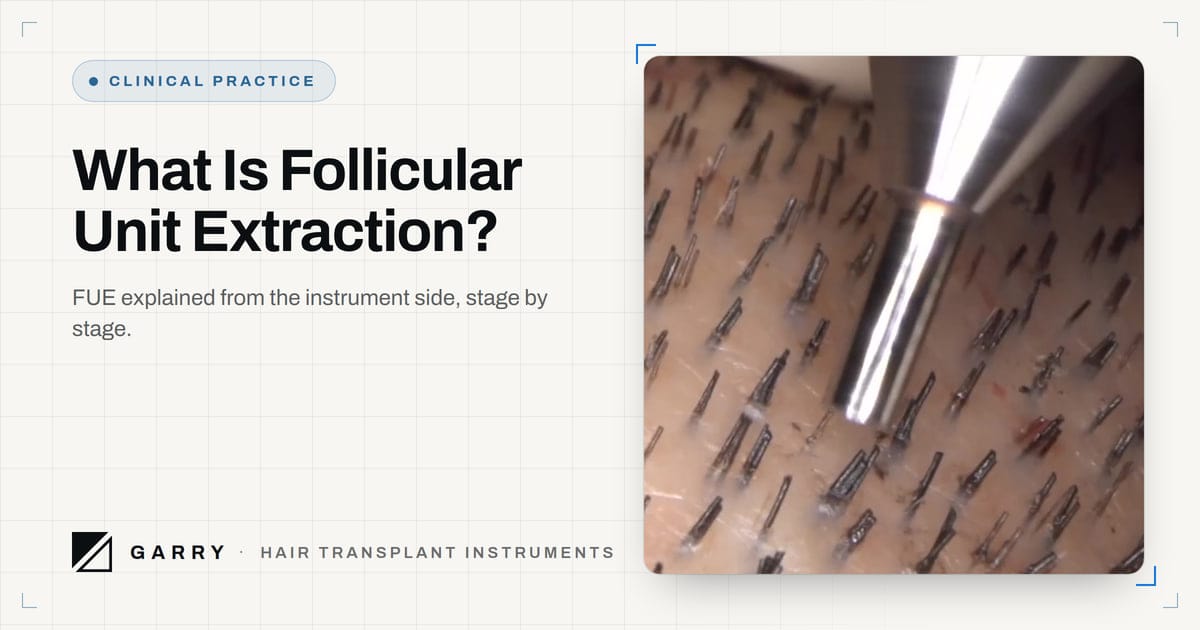
Follicular unit extraction - FUE - is the technique behind most modern hair transplants, and most explanations of it are written for patients. This one is written for the people who run the procedure - clinic owners, surgeons building a protocol, and dealers who need to understand what they are actually selling. We make FUE instruments for a living, so this guide follows the technique the way an instrument maker sees it - stage by stage, tool by tool.
The one-sentence definition
Follicular unit extraction is the harvesting of individual follicular units - the naturally occurring bundles of one to four hairs - directly from the donor area using a small circular cutting instrument called a punch, rather than removing a strip of scalp and dissecting it under magnification (that older approach is FUT, follicular unit transplantation).
The whole character of FUE flows from that choice - no linear strip, no linear scar, but thousands of individual micro-excisions - each one performed by hand, each one passing through the edge of a punch.
The three instrument stages
A complete FUE case is really three procedures in sequence, and each stage has its own instrument family.
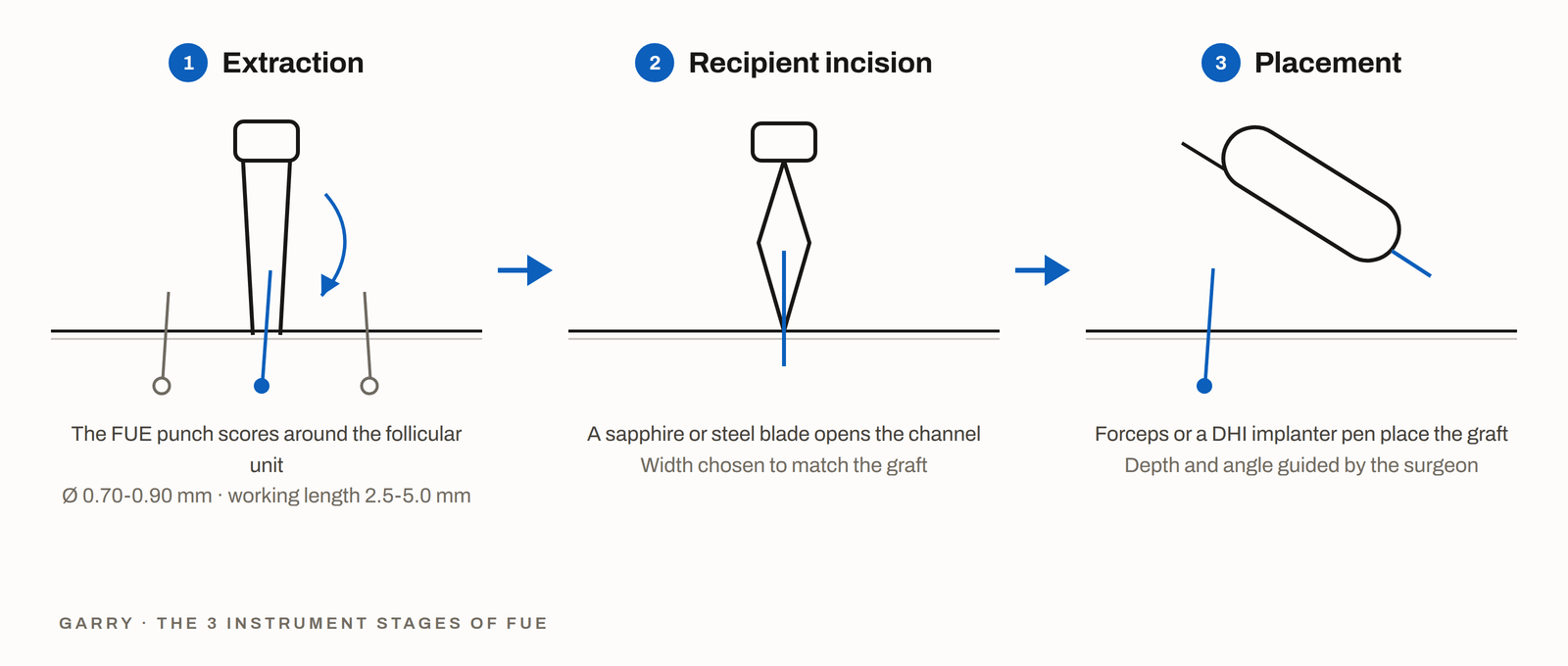
1. Extraction - the punch
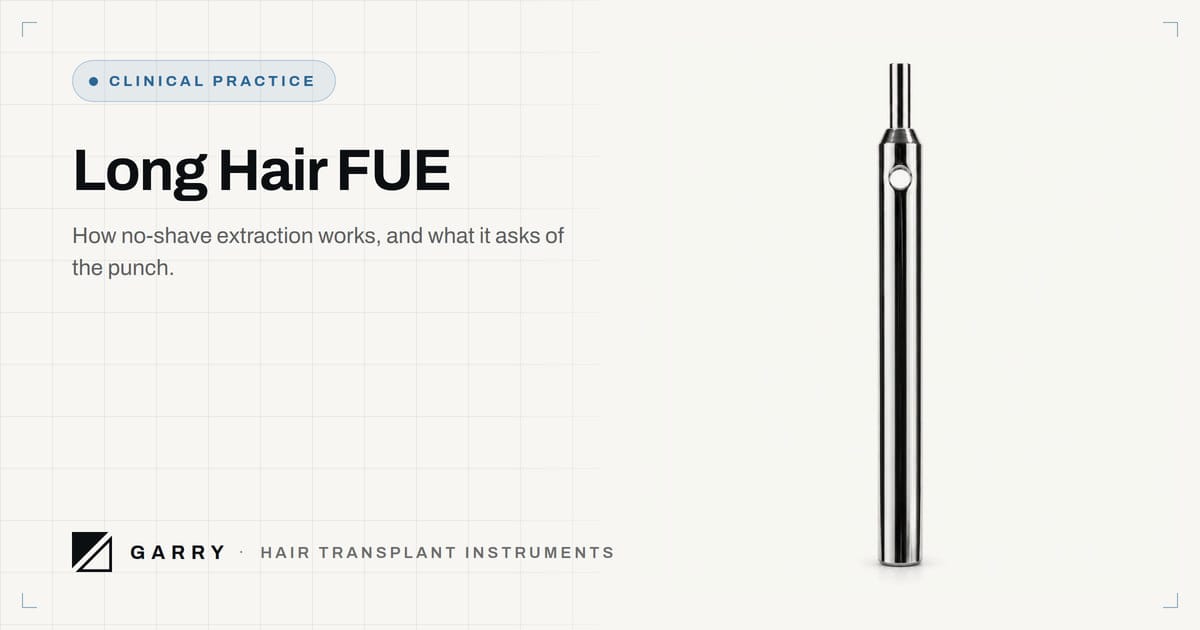
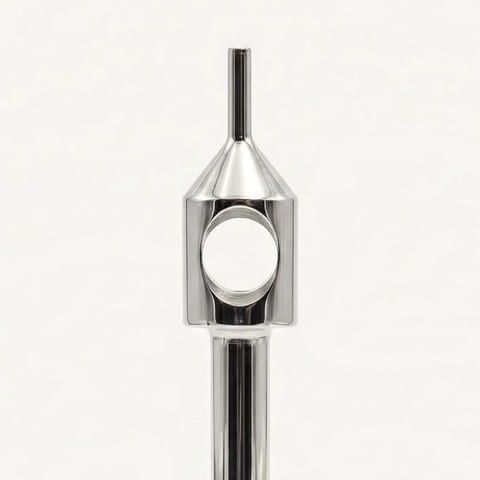
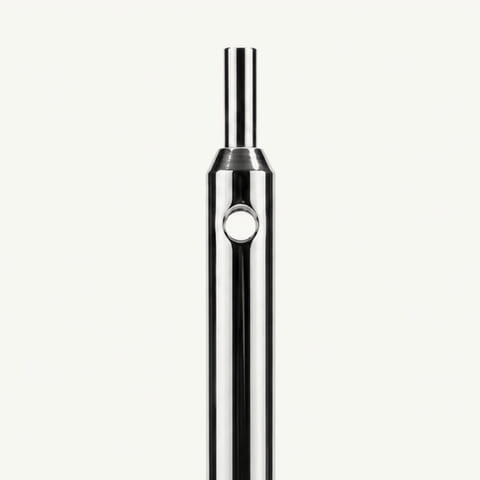
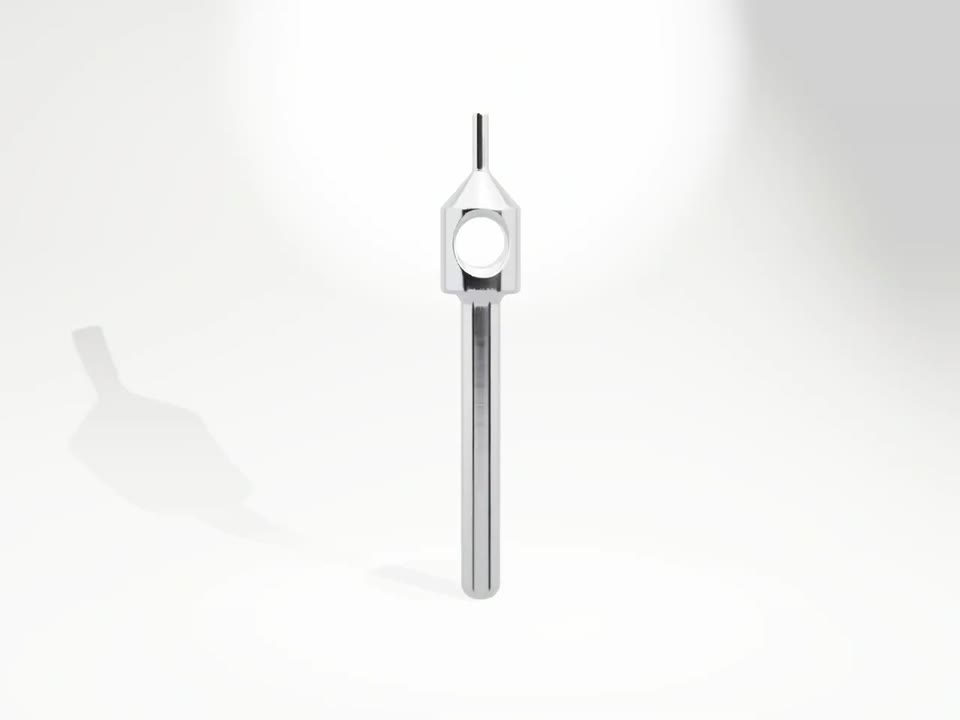
The punch is a thin-walled cylinder, typically Ø 0.70-0.90 mm in diameter with a working length around 3.0-4.0 mm, that scores the skin around a follicular unit so the graft can be freed and lifted. It is the stage where FUE is won or lost - the punch edge decides how cleanly the unit separates from surrounding tissue and how much protective tissue travels with the graft.
Punch geometry - not just size - is the real design variable. Edge designs differ in how they engage the skin.
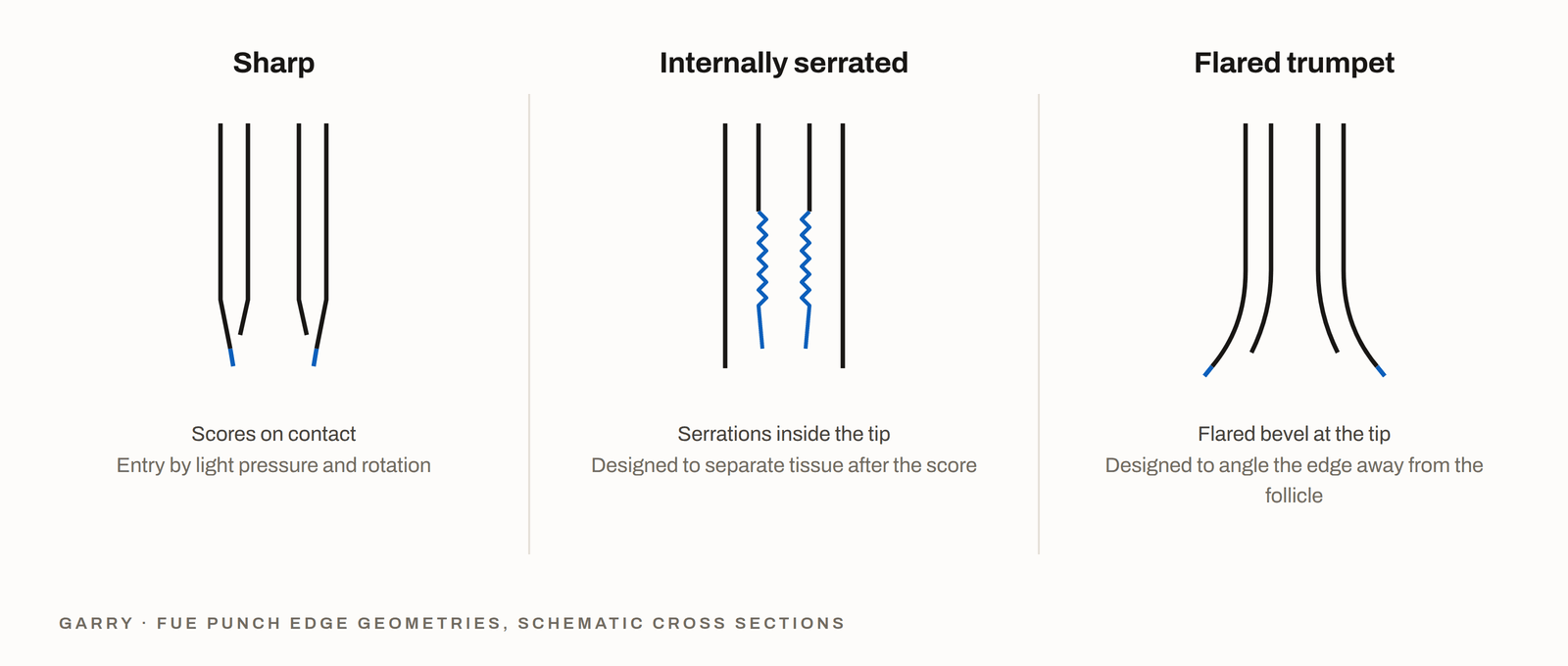
- Sharp geometries score the epidermis with minimal downward pressure - entry is by contact and rotation, which suits surgeons who work by feel.
- Separating geometries use internal serrations so that after the initial score, the punch is designed to separate tissue planes rather than keep cutting - the intent is to preserve the fatty envelope around the graft.
- Hybrid / flared geometries put a trumpet-shaped bevel at the tip, designed to steer the cutting edge away from the follicle as depth increases - useful orientation for fibrotic or scarred donors.
The Garry FUE punch line runs from Ø 0.7 to 0.9 mm in 5 working lengths, with one order code per diameter and working length, and every size has a serrated cutting tip. Our FUE punch size selection guide explains how diameter and working length are chosen.
2. Recipient-site creation - the blade
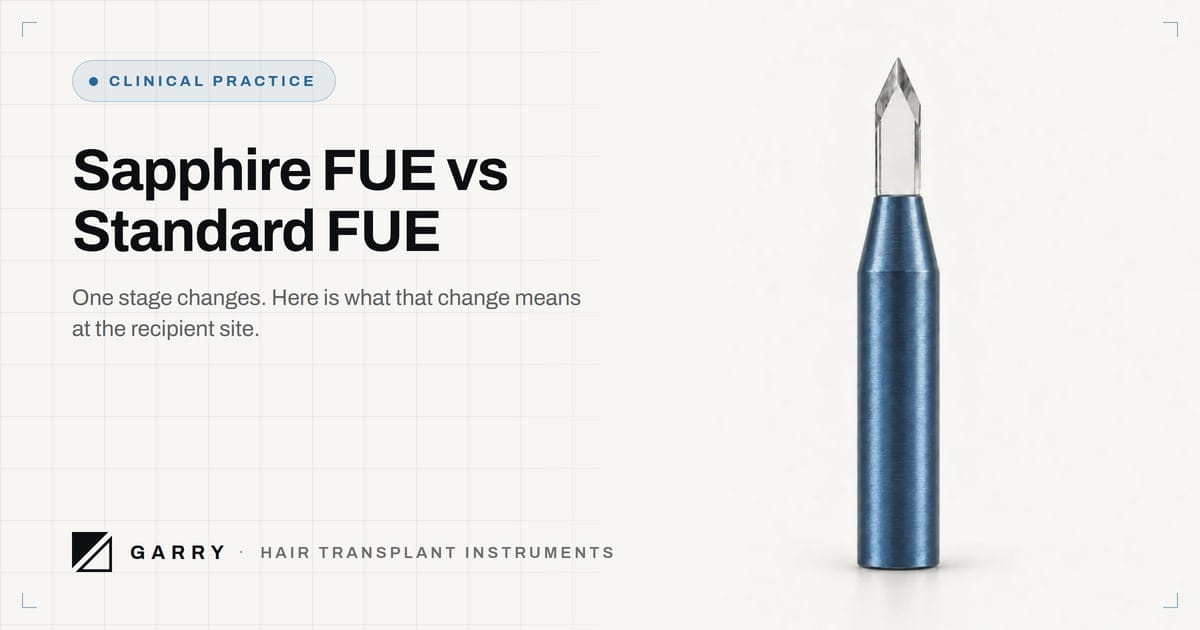
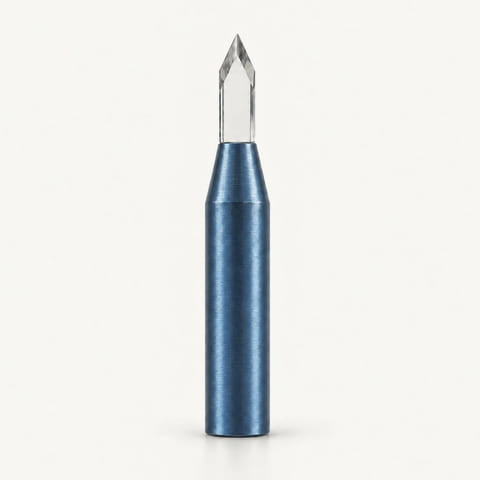
Before grafts can be placed, the recipient area needs channels. In slit-based protocols these are opened with a blade - hardened steel, or sapphire crystal, whose crystalline edge is designed to hold a fine, consistent geometry through long dense-packing sessions. Blade width is matched to graft caliber; the blade sits in a dedicated holder that controls exposed depth.
3. Placement - forceps or implanter
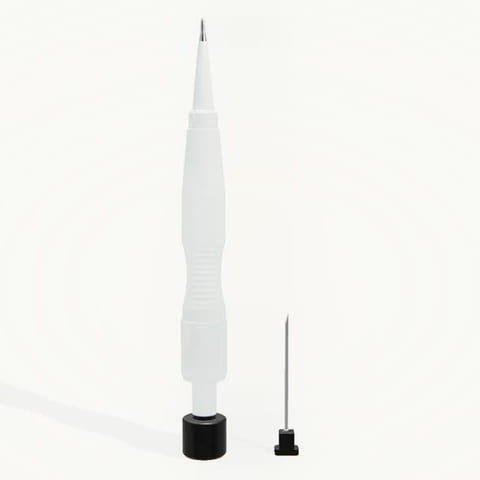
Grafts are placed either with fine forceps into pre-made channels, or with a DHI implanter pen - a spring-loaded instrument that opens the channel and places the graft in one motion. The DHI route removes the separate incision stage for those grafts; the trade-off is a loading step and a per-graft rhythm that teams must train for. We return to this in the FUE versus DHI section below.
FUE versus FUT - the instrument view
| Aspect | FUT (strip) | FUE |
|---|---|---|
| Harvest instrument | Scalpel (strip excision) + microscope dissection | Punch, unit by unit |
| Donor scar pattern | Single linear scar | Distributed micro-scars |
| Instrument sensitivity | Dissection skill dominates | Punch edge and geometry dominate |
| Team structure | Dissection team at microscopes | Extraction rhythm at the donor site |
Neither technique is "obsolete"; FUT persists in specific indications. But the market has moved decisively toward FUE, and with it the clinical burden has moved onto punch quality - a strip harvest can tolerate a mediocre scalpel, while four thousand individual excisions are far less forgiving of a mediocre punch.
FUE versus DHI - not competitors
Contrary to a common assumption, DHI is not an alternative to FUE. Direct hair implantation still harvests grafts with an FUE punch; what changes is the placement stage, where the implanter pen replaces pre-made channels plus forceps. A clinic "doing DHI" is doing FUE extraction with implanter placement. That is why serious instrument planning treats the punch and the implanter needle as one system - the needle bore has to accept the grafts your punch produces.
What "good instrumentation" means in FUE
Because FUE distributes the surgical work across thousands of small actions, instrument quality expresses itself differently than in open surgery.
- Edge consistency. The punch used on graft number three thousand should behave like it did on graft number three. This is why we inspect instruments individually rather than by batch sampling.
- Geometry matched to the donor. Elastic scalps, fibrotic scars and fine calibers do not call for the same edge. Stocking more than one geometry is normal practice, not a luxury.
- Reorderable sizes. When a size becomes part of the protocol, the next delivery has to be that exact size, not something close to it. Every GARRY size carries its own order code, so a clinic reorders the same specification instead of describing it again.
- A planned system. Punch diameter, blade width and implanter needle size interact. Choosing them together - rather than accumulating them piecemeal - is what separates a designed protocol from an improvised one.
Frequently asked questions
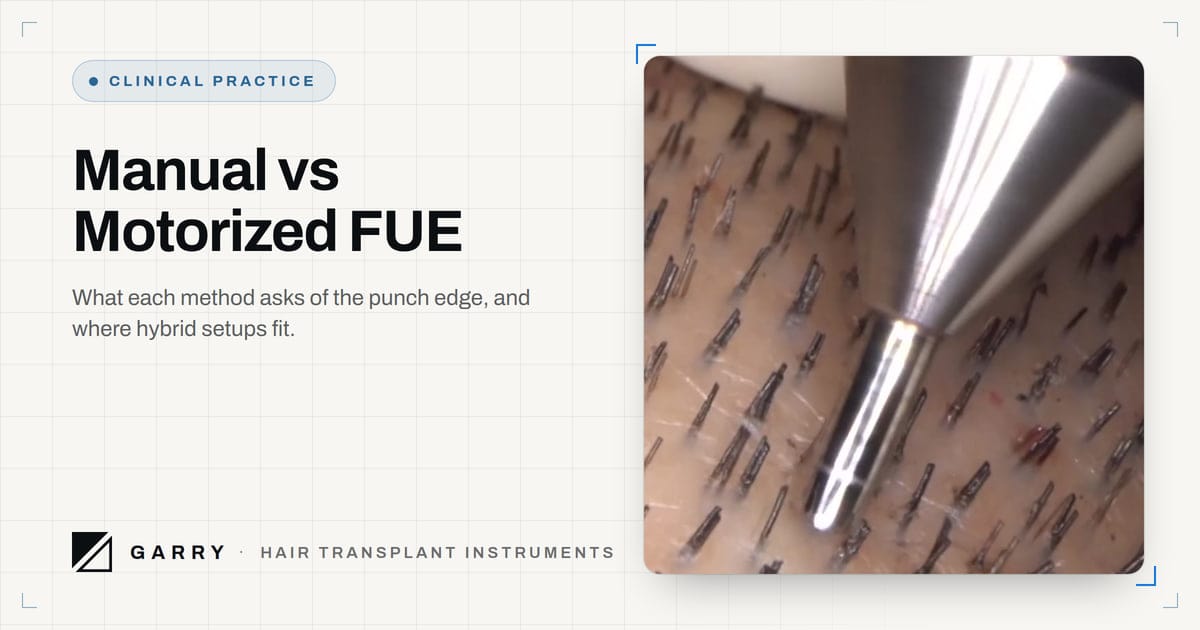
Is FUE a machine or a technique? A technique. It can be performed with manual punches or motorized handpieces - see our comparison of manual and motorized FUE instrumentation - but the defining feature is unit-by-unit extraction, not the power source.
What instruments does a clinic need to start FUE? At minimum, it needs a ladder of punch diameters in at least one geometry, recipient-site blades with a matched holder (unless running full-DHI placement), placement forceps or implanter pens with needles, and the sterilization workflow to support them.
Does the punch really matter that much? The punch touches every single graft in the case. It is the highest-leverage instrument decision in the protocol.
Where can I see the punch sizes mentioned here? The Fue Punch family page lists every published diameter and working length with its order code, and the punch selection chart sets them side by side.
We manufacture the full FUE instrument chain - punches, sapphire blades, implanters and our own Garry Smart Fue System - in Türkiye, and supply clinics and dealers direct. Request a quote with your protocol and sizes; we reply within 24 hours on business days, and evaluation quantities are available so your surgeons decide on real tissue.