Sapphire Blade Sizes - Widths, Blade Lengths and Order Codes
Sapphire blade sizes are stated as a width and a blade length. This guide explains how a width is matched to graft calibers and zones, how it works with the depth set at the holder and how to read the 28 order codes of the Garry Sapphire Blade, 1.1 to 1.7 mm wide.
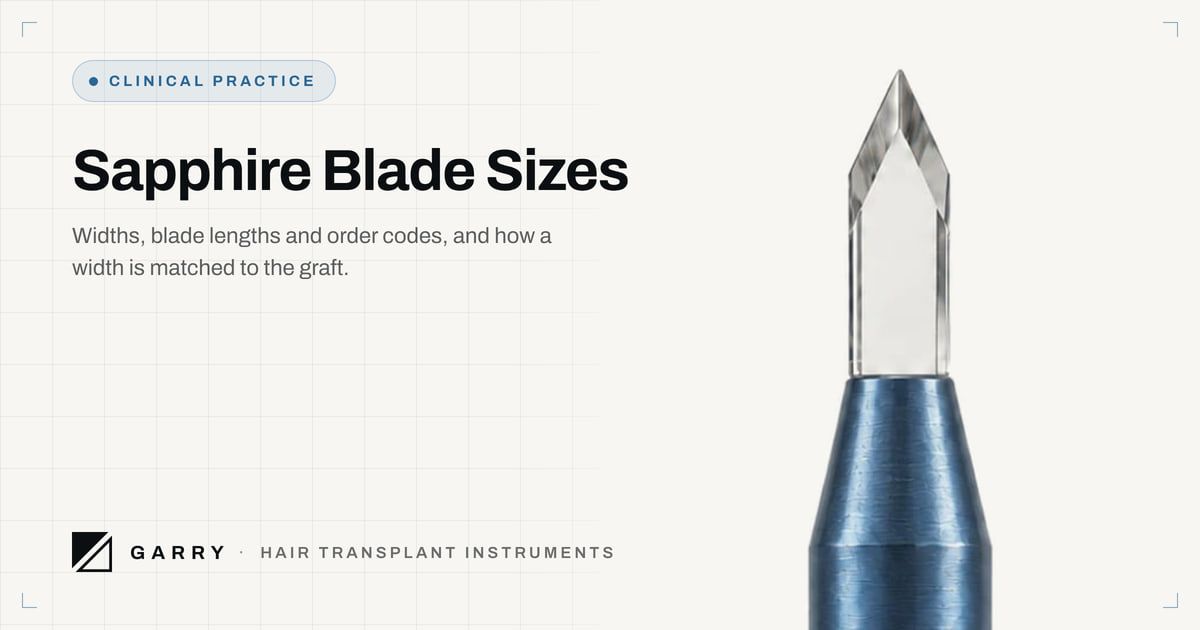
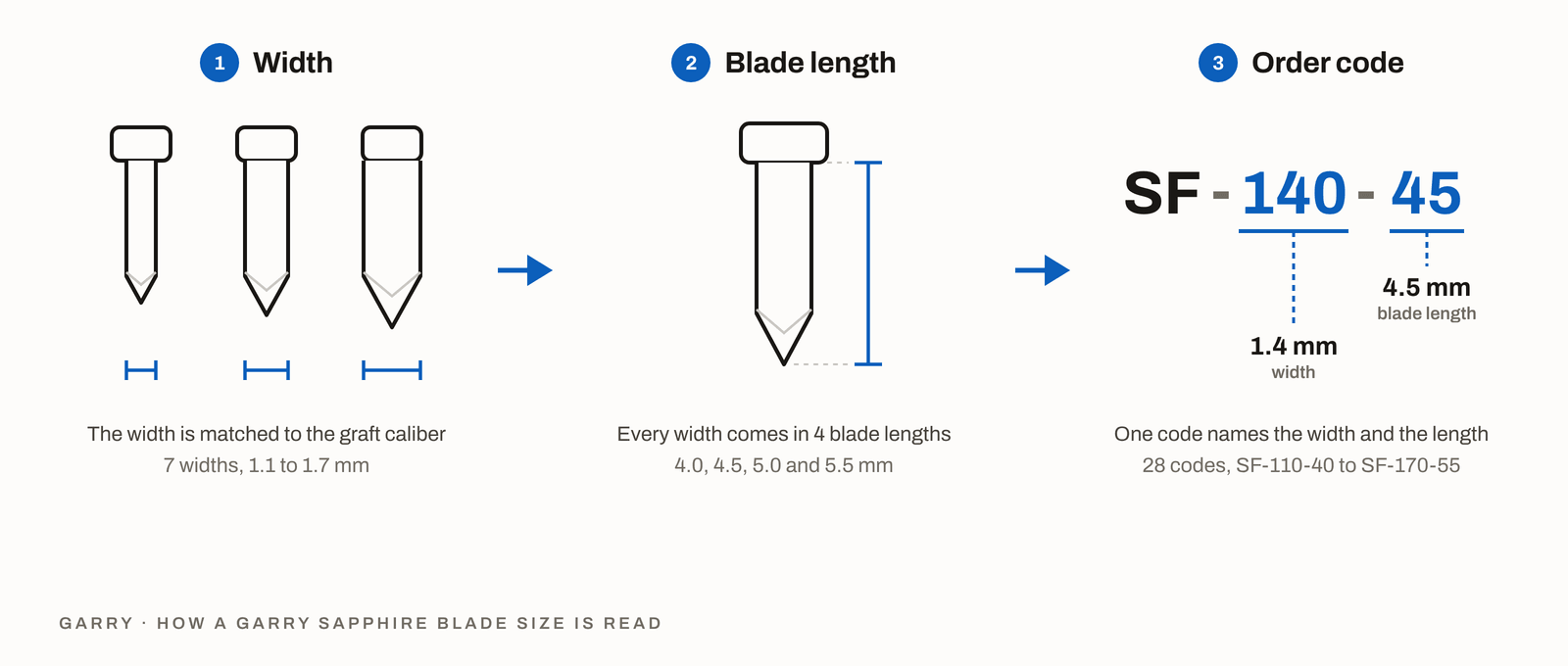
Sapphire blade sizes are stated as 2 numbers, the width of the cutting tip and the length of the blade. The width is the number that follows the graft, because it sets the width of the recipient channel a graft is placed into, and it is the first thing a clinic decides when it orders. The Garry Sapphire Blade is made in 7 widths, 1.1, 1.2, 1.3, 1.4, 1.5, 1.6 and 1.7 mm, and every width comes in 4 blade lengths, 4.0, 4.5, 5.0 and 5.5 mm. That gives 28 sizes, each with its own order code, from SF-110-40 to SF-170-55. This guide explains what each number means, how a width is matched to graft calibers and zones, how the width works together with the depth set at the holder, why clinics stock a range of widths and how to read and order the codes, with the Garry Sapphire Blade as the worked example.
What a sapphire blade size describes
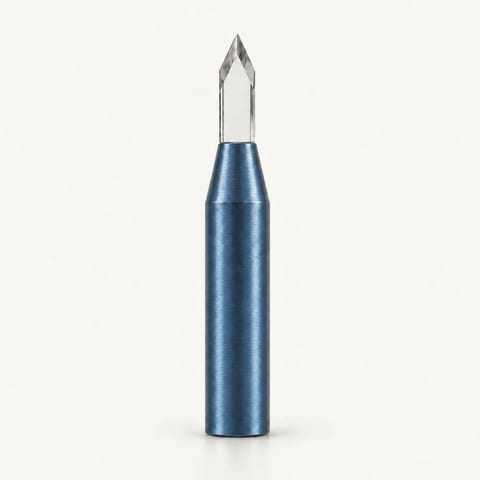
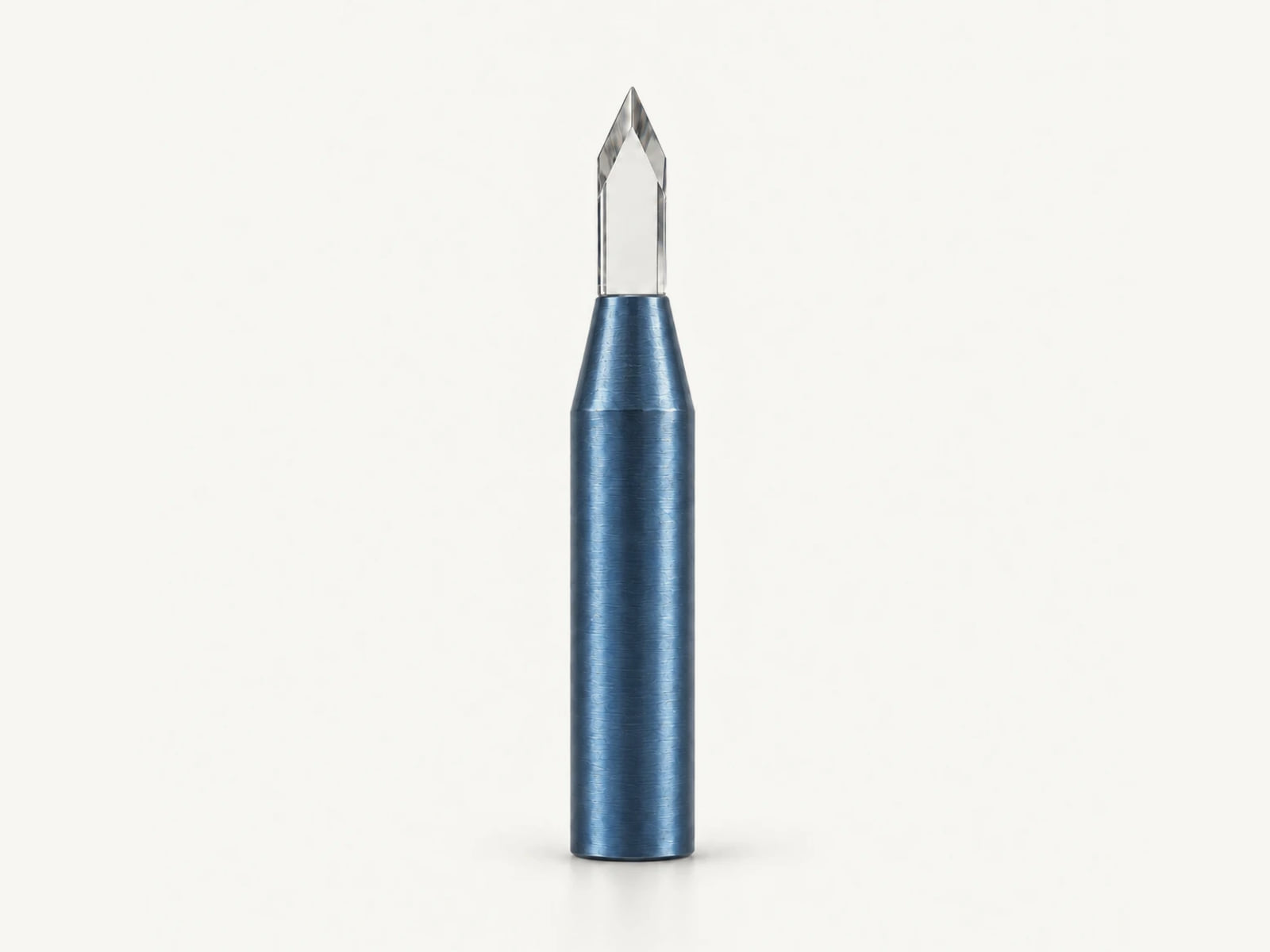
A sapphire blade is the recipient-site instrument of Sapphire FUE. It opens the channels into which the grafts are placed, after extraction with a punch and before placement, as our FUE instrument guide sets out stage by stage. The blade has a tip of sapphire crystal, on the Garry blade a V-shaped tip designed for micro-channel creation, held in a mount that sits in the clinic's blade holder.
2 dimensions are published for every Garry Sapphire Blade.
Width. The width of the sapphire crystal tip, from 1.1 to 1.7 mm in steps of 0.1 mm. The width of the blade sets the width of the channel, so it is chosen for the graft that the channel will receive.
Blade length. 4.0, 4.5, 5.0 or 5.5 mm, the same 4 lengths at every width. The length follows the clinic's own protocol and its holder, and it is confirmed on the quotation.
A third number matters at the chair but is not a property of the blade, the depth of the channel. Depth is set at the holder, which controls how much of the blade is exposed, and it has its own section below. Thickness, angle options and the mount format are not published on the site and are confirmed in writing on the quotation, together with the fit to the holder a clinic uses.
The 7 widths and what each is chosen for
The table gives the use each width is typically chosen for and its order codes, one code per blade length.
| Width | Typically chosen for | Order codes |
|---|---|---|
| 1.1 mm | Hairline zones and fine single-hair grafts, the narrowest width | SF-110-40 to SF-110-55 |
| 1.2 mm | Fine grafts and transition zones, a narrow width | SF-120-40 to SF-120-55 |
| 1.3 mm | Everyday recipient work, a narrow-to-standard width | SF-130-40 to SF-130-55 |
| 1.4 mm | Mixed follicular units, the standard width | SF-140-40 to SF-140-55 |
| 1.5 mm | Fuller units, a standard-to-wide width | SF-150-40 to SF-150-55 |
| 1.6 mm | Multi-hair units, a wide width | SF-160-40 to SF-160-55 |
| 1.7 mm | The largest grafts, the widest width | SF-170-40 to SF-170-55 |
The steps are 0.1 mm, so neighbouring widths sit close enough for a team to move one step when a graft mix runs finer or fuller than planned. The table is a starting point and not a rule. The final choice follows the measured graft caliber and the surgeon's plan. Widths narrower than 1.1 mm or wider than 1.7 mm, other blade lengths and custom sizes are not offered.
Matching the width to the graft and the zone
The rule for choosing a width is short. The blade width is matched to the graft caliber and to the site plan, and a blade matched this way is designed to open a channel that fits the unit rather than a larger wound.
A graft is a follicular unit of 1 to 4 hairs taken with the tissue around it, and the units of one patient are not all the same size. Single-hair grafts are the finest, and multi-hair units carry more tissue and need more room. The zones of the recipient area use them differently. Fine single-hair grafts go to the hairline, so the hairline is opened with the narrow widths, and multi-hair units go to the mid-scalp behind it, so the mid-scalp is opened with the wider ones.
Because the grafts come from the donor area, the plan runs from the donor area forward. The punch diameters chosen for the donor profile set the calibers that come off the donor area, and the blade widths are chosen to seat those calibers. The table below sets the 2 instruments side by side, as our guide to what a hair graft is does for the whole instrument table.
| Graft type | Fue Punch inner diameter | Sapphire Blade width |
|---|---|---|
| Finest single-hair units | Ø 0.60 to 0.65 mm | 1.1 mm |
| Fine single-hair grafts | Ø 0.70 mm | 1.1 to 1.2 mm |
| Mixed follicular units | Ø 0.75 to 0.80 mm | 1.3 to 1.4 mm |
| Fuller multi-hair units | Ø 0.85 mm | 1.5 mm |
| Multi-hair units and coarse calibers | Ø 0.90 mm | 1.6 to 1.7 mm |
The numbers in the 2 columns are not on the same scale. A punch is specified by the inner diameter of a round opening and a blade by the width of its cutting tip. What links them is the graft, which is why the 2 sizes are planned together.
The orientation of the incisions is part of the same decision. Lateral incisions, also called coronal, sit perpendicular to the direction of hair growth, and sagittal incisions run parallel to it. Both can be made with a sapphire blade, and the width choice follows the orientation, so teams pick their widths for the incision pattern and the graft calibers in the plan. The glossary defines both terms.
How the width works with the depth set at the holder
Width and depth are 2 separate decisions, made in 2 different places. The width is decided when the blade is ordered, because it is a property of the blade and part of its order code. The depth is decided at the chair. With a sapphire blade the channel depth is set by the holder, the handle the blade mounts into, which controls how much of the blade is exposed. The principle is the same as with a steel blade.
In a recipient session the blade width is matched to the graft caliber, the holder sets the exposed depth, and the channel map is made before the first graft is placed. The depth itself is part of the surgeon's plan and is not something a blade size decides. Changing to a wider blade changes the width of the channel, and the depth stays what the holder exposes.
This is why the holder matters as much as the blade. The holder should be secure and well matched to the blade, so that the brittle sapphire edge is protected and the surgeon keeps control. A loose or ill-fitting holder is a risk to the tip. The Garry range does not include blade holders, so the fit of the blade to the holder a clinic already uses is confirmed in writing on the quotation, before the order.
The blade length belongs to the same conversation. Every Garry width is made in 4 blade lengths, 4.0, 4.5, 5.0 and 5.5 mm, and the length is stated in the order code. Which length a clinic orders follows its own protocol and its holder, and it is confirmed on the quotation. We do not publish a general rule for choosing one length over another, so the practical step is to name the holder and the lengths in use when asking for a quote.
Why clinics stock a range of widths
A real case is rarely one graft type, so one width is rarely enough. Most teams run 2 or 3 sapphire blade widths per case and step through them across the zones of the scalp, for example a narrow width at the hairline and a wider one for the multi-hair units behind it.
For a clinic, that becomes a short width ladder on the shelf rather than a single size. 3 points shape the ladder.
The graft mix. A practice that places many fine single-hair grafts leans to the narrow end of the range, and one that places fuller multi-hair units leans to the wide end. Neighbouring widths cover the spread of a mix.
The service life of the blade. The Garry Sapphire Blade is reusable and is designed for a total of up to 30,000 channel openings, with cleaning and steam sterilization at 134 °C between uses. That figure helps a clinic plan when a width will need replacing. A blade whose edge shows any chip or damage is replaced, whatever the number of channels it has opened.
The brittleness of sapphire. Sapphire crystal is hard but brittle, and a blade can chip if it is dropped, pried sideways or knocked against a metal tray. Holding a spare of each width in use means a chipped blade does not interrupt a session.
Some clinics also mix materials or methods by zone, with sapphire channels for one part of the plan and steel blades or implanter pens for another. Our sapphire vs steel guide compares the 2 blade materials, and the guide to implanter needle sizes covers the needle bores used in DHI placement.
How to read a sapphire blade order code
Every Garry Sapphire Blade size has one order code, and the code states both dimensions. The letters SF name the family, the first number gives the width and the second number gives the blade length.
- SF-110-40 is the blade 1.1 mm wide and 4.0 mm long.
- SF-140-45 is the blade 1.4 mm wide and 4.5 mm long.
- SF-170-55 is the blade 1.7 mm wide and 5.5 mm long.
7 widths in 4 lengths give 28 codes, from SF-110-40 to SF-170-55. Each of them is its own catalog entry with its own product page, for example the Garry Sapphire Blade 1.4 mm - 4.5 mm, and the family page lists them all.
Ordering by code has 2 practical effects. A quotation lists every size by its code, so it can be checked line by line against what the surgeons asked for. And a reorder names the same width and length as the first delivery, because each code refers to one defined specification. Every blade is inspected individually before it ships, and there is no sampling plan.
A quote request for sapphire blades is complete when it names 4 things, the widths, the blade length for each width, the quantities and the holder the clinic uses. Any of the 28 codes can be mixed in one request. Pricing is provided by quotation and is not published on the public site, and the minimum order, the lead time and the shipping terms are confirmed on the quotation.
Handling that keeps the edge intact
A width is only as useful as the edge that carries it, so handling is part of working with sizes. The Garry Sapphire Blade is supplied non-sterile and is steam sterilized at 134 °C before use. Handle the blade by the mount only, keep the edge away from metal instruments and hard trays during cleaning, sterilization and storage, and give the tip a brief magnified inspection before each session and on delivery. A blade whose edge shows any damage is replaced by its order code. Garry does not re-sharpen or refurbish blades.
Questions buyers ask about sapphire blade sizes
Which sapphire blade width is used for the hairline? The 1.1 mm blade, order codes SF-110-40 to SF-110-55, is the width typically chosen for hairline zones and fine single-hair grafts, and it is the narrowest width in the range. The 1.2 mm blade is a narrow width for fine grafts and transition zones.
How many widths does a team use in one case? Most teams run 2 or 3 widths per case and step through them across the zones of the scalp. A first order can therefore be a short width ladder built from the clinic's graft calibers and zone plan.
Does the blade width set the depth of the channel? No. The width sets how wide the channel is. The depth is set by the holder, which controls how much of the blade is exposed, and it is part of the surgeon's plan.
Which blade length should I order? Every width comes in 4 blade lengths, 4.0, 4.5, 5.0 and 5.5 mm. The length follows your own protocol and your holder and is confirmed on the quotation, so name the holder and the lengths you use in the quote request.
Does Garry make widths outside 1.1 to 1.7 mm? No. The Garry Sapphire Blade is published in 7 widths from 1.1 to 1.7 mm, each in 4 blade lengths, and sizes outside that range and custom sizes are not offered. The Sapphire Blade questions and answers cover the line in more depth.
Ordering Garry Sapphire Blades by size
Send the widths, blade lengths and quantities you need, or your zone plan, session profile and holder, through the contact page, and we answer in writing within 24 hours on business days, with a suggested starting set where you ask for one. A small first order across the widths you are considering can be quoted, so your surgeons can compare the blades with their current ones in comparable sessions before the clinic standardizes. The blades are supplied direct from the manufacturer in Türkiye, with no importer in between, and distributors who want to carry the line can apply for a dealer account.