DHI Hair Transplant Explained - The Implanter Pen and Needle
DHI hair transplantation changes one stage of the procedure, graft placement. This guide explains how the implanter pen and its hollow needle load, place and release each graft, how needle size follows the graft, and what a clinic needs to run DHI well.
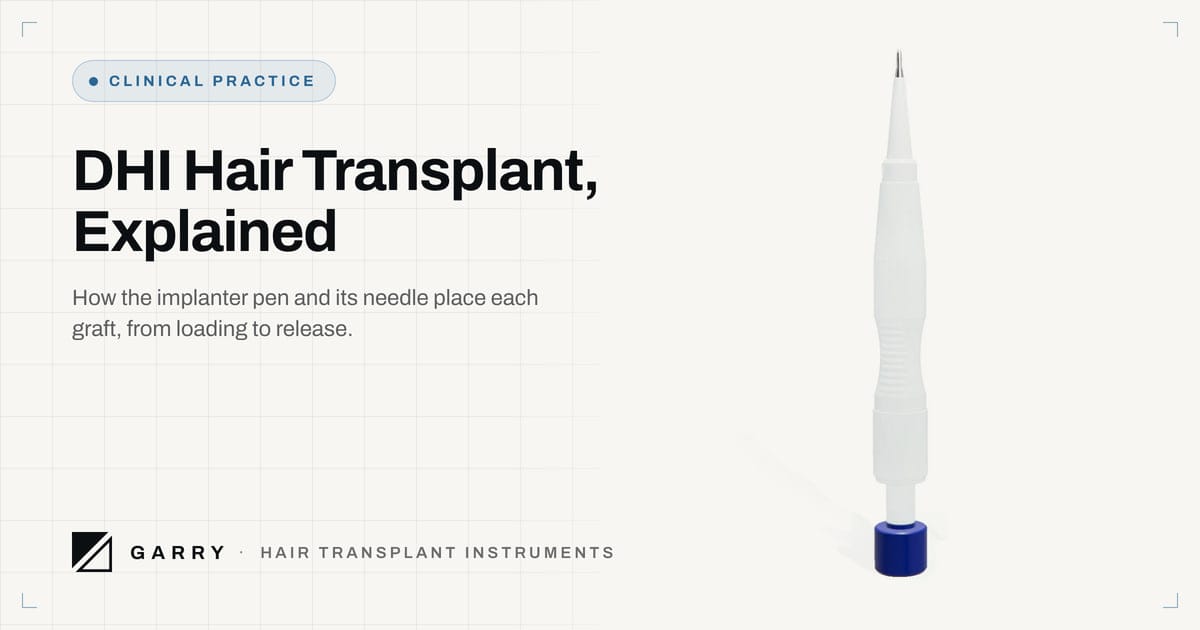
DHI hair transplantation, short for direct hair implantation, is FUE with a different placement stage. Grafts are still extracted one by one with an FUE punch, but instead of opening recipient channels first and placing grafts into them with forceps, the team loads each graft into the hollow needle of an implanter pen and places it in one motion. The needle opens its own channel and the pen's spring-loaded plunger releases the graft as the needle withdraws. Everything distinctive about DHI, from the team rhythm to the stock list, follows from that one instrument, so this guide explains the technique from the instrument side, using the Garry DHI Implanter Pen and its matching needle as the worked example.
What DHI changes in a hair transplant
A hair transplant has 3 instrument stages. Extraction removes follicular units from the donor area, channel opening prepares the recipient sites, and placement seats the grafts. In a standard FUE workflow each stage has its own instrument. A punch extracts, a steel or sapphire blade opens the channels in advance, and fine forceps place each graft into a channel that is already there.
DHI keeps the first stage exactly as it is and merges the other 2. The implanter pen opens the site and places the graft in the same motion, so there is no separate channel-opening session for the grafts placed with the pen. That is the whole technical difference, and it is worth stating plainly because the name is often marketed as if it described a different way of harvesting. It does not. A DHI case begins at the donor area with a punch, exactly like any FUE case, and the choices made there, punch diameter, working length and whether the donor is shaved, are made the same way. Our DHI versus FUE comparison sets out the full instrument list for each workflow.
What changes is the placement table. Instead of a tray of channels and a pair of forceps, the surgeon works with several loaded pens, technicians load grafts into the next pens while the surgeon places, and the stock list gains a new consumable, the implanter needle.
How the implanter pen works, step by step
Every DHI implanter pen works on the same principle, and the Garry pen follows it in 3 steps.
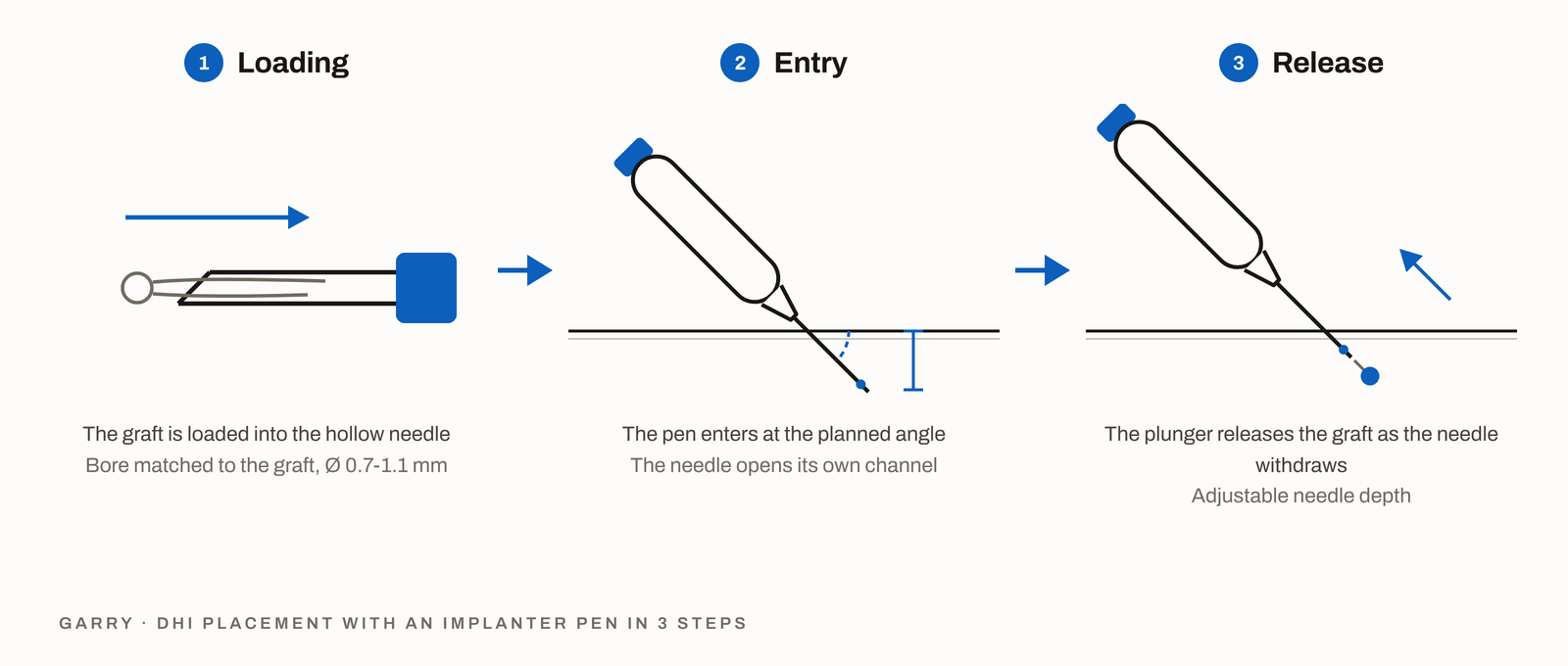
- Loading. A technician places the extracted graft into the needle tip, so that the graft sits inside the hollow needle ready to be released. The needle bore is chosen for the graft caliber, which is why loading is the step where a wrong size shows first. A bore that is too small squeezes the graft at loading, and a bore that is too large lets it sit loose.
- Entry. The surgeon sets the pen at the planned angle and direction and enters the scalp. The needle opens its own channel as it goes in, so no channel needs to exist beforehand. The depth of entry is set before the session by the length of needle exposed beyond the pen.
- Release. The surgeon presses the plunger, and the spring-loaded mechanism releases the graft as the needle withdraws, leaving the graft seated in the channel the needle has just made. The pen then goes back to a technician to be loaded again.
Because loading has no equivalent in the forceps workflow, it is the step that dominates the learning curve. Teams that move to DHI usually train loading first and placement second.
Inside the instrument, pen and needle
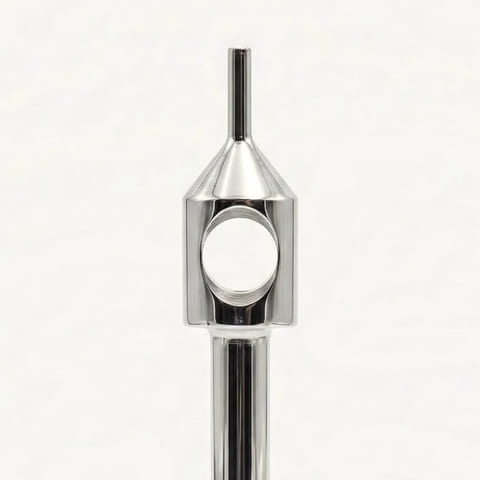
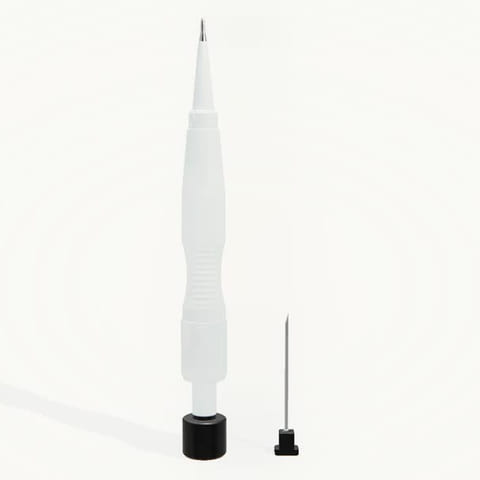
An implanter pen is 2 products that work as 1. The pen is the reusable handpiece, and the needle is the part that holds the graft, enters the tissue and is replaced as it wears.
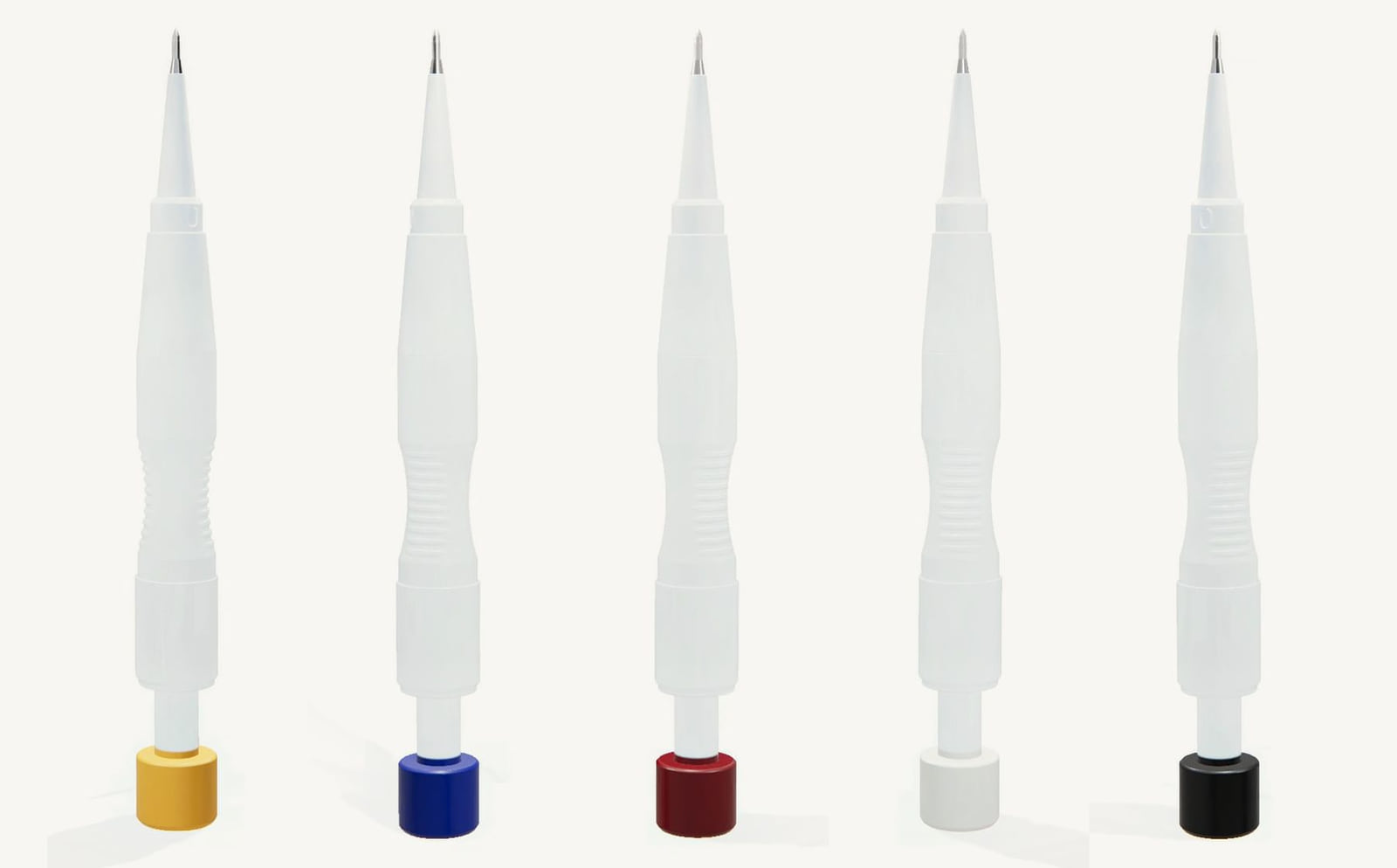
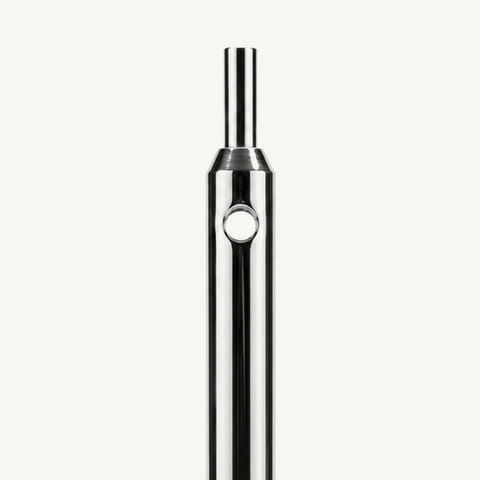
The Garry DHI Implanter Pen is made of medical-grade steel and built around 4 working parts.
- The body, which the surgeon holds like a pen and which disassembles without tools for cleaning and sterilization.
- The spring-loaded plunger, which pushes the graft out of the needle on release and returns for the next load.
- The positive needle seat, which holds the needle at a defined position, so the exposed length that sets placement depth stays where it was set.
- The coloured cap, which identifies the size at a glance.
The Garry DHI Implanter Needle is crafted from Japanese Steel (Garry J-Steel), the same material as the Garry Fue Punch. It is hollow, its bore is the published size, and its hub carries the same colour as the pen cap of that size. A needle seats in the pen by that hub, so a replacement needle of the same order code returns the pen to its set exposed length without re-calibration.
Both instruments are manufactured in Türkiye, inspected individually before release and supplied non-sterile. Each size of each instrument is its own catalog entry with its own order code, which matters later, when a clinic reorders.
Sizing the needle to the graft
The single most important number in DHI is the needle bore, because it has to match what the extraction produced. Grafts vary in caliber with the number of hairs they carry and with the patient's hair, so a real case usually places more than one caliber, and most teams run 2 or 3 sizes side by side. The Garry range covers 5 sizes, and pen and needle share the size, the order code digits and the colour.
| Size | Pen order code | Needle order code | Colour | Published guidance |
|---|---|---|---|---|
| Ø 0.7 mm | DHI-PEN-070 | DHI-TIP-070 | Yellow | Finest bore, single-hair grafts and fine calibers |
| Ø 0.8 mm | DHI-PEN-080 | DHI-TIP-080 | Blue | Fine bore, single-hair grafts and fine calibers |
| Ø 0.9 mm | DHI-PEN-090 | DHI-TIP-090 | Red | Standard bore for mixed follicular units |
| Ø 1.0 mm | DHI-PEN-100 | DHI-TIP-100 | White | Larger bore for fuller multi-hair grafts |
| Ø 1.1 mm | DHI-PEN-110 | DHI-TIP-110 | Black | Largest bore, coarse calibers and large units |
Read the table from the donor area forward. The punch diameter and the donor hair set the caliber of the grafts that come off the donor area, so the needle sizes are planned together with the punch diameters rather than after them. A team extracting with Garry Fue Punches in Ø 0.8 and 0.85 mm, for example, typically maps the calibers that mix produces and then stocks the 2 or 3 needle sizes that seat that spread. The reasoning is laid out in detail in our guide to implanter needle sizes, and the final choice of size for any zone is the surgeon's.
The colour system exists for the loading station. When several loaded pens are in rotation, the technician hands over a blue pen for a single-hair graft at the hairline and a red one for the mixed units behind it, and nobody has to read a number on a small instrument in the middle of a session.
Depth, angle and the team rhythm
Implantation depth on an implanter pen is set by the exposed needle length, the part of the needle that protrudes beyond the pen's seat. On the Garry pen that length is adjustable, and the positive needle seat holds the setting across needle changes. In practice this means depth is decided once, before the session, and checked rather than reset during it. Angle and direction stay entirely in the surgeon's hands, which is why surgeons who prefer direct control often choose pen placement for zones such as the hairline.
The team rhythm is the other half of DHI. A typical setup runs several pens in rotation. Technicians load grafts into waiting pens while the surgeon places with another, so placement does not wait for loading. How many pens a team needs depends on team size, graft volume and the number of sizes in the plan, and it is a question better answered from your own protocol than from a rule of thumb. When clinics send us their team size and graft mix, the suggested set comes back as a list of order codes.
Before each session the checks are short and specific.
- The needle is seated firmly in the pen.
- The exposed length matches the planned depth.
- The spring returns cleanly after a test press.
- The needle tip shows no damage under magnification.
DHI, FUE and Sapphire FUE side by side
These 3 names are often presented as competing techniques. They are better understood as answers to different questions, because each one names a different stage.
| Stage | Standard FUE | Sapphire FUE | DHI |
|---|---|---|---|
| Extraction | FUE punch | FUE punch | FUE punch |
| Channel opening | Steel blade, in advance | Sapphire blade, in advance | Implanter needle, at placement |
| Placement | Forceps | Forceps | Implanter pen |
| Added consumable | Blades | Sapphire blades | Implanter needles |
| Main training focus | Placement with forceps | Blade handling and width planning | Graft loading |
Mixed protocols are common. Many teams open channels with sapphire blades for the bulk of a plan and use pen placement where the surgeon wants direct control, and the same punch serves both. Shaving is not decided by DHI either. It follows the extraction plan, and unshaven cases are extracted with a punch designed for long hair, such as the Garry Long Hair Fue Punch.
Reprocessing and needle life
The Garry DHI Implanter Pen and Needle are supplied non-sterile and are cleaned and steam-sterilized at 134 °C before first use and before every subsequent use. The pen goes into the sterilizer disassembled, because an assembled spring-loaded pen shields its internals from steam, and a prevacuum cycle is the right choice for a load like this, as our guide to gravity and prevacuum cycles explains.
The routine in short.
- At the point of use, keep the pen and needles moist and flush the needle channels with water before debris dries.
- Disassemble the pen without tools and clean the components with a neutral-pH detergent.
- Rinse and dry thoroughly, then steam sterilize at 134 °C.
- Reassemble and check the spring action.
- Inspect each needle tip before the next session.
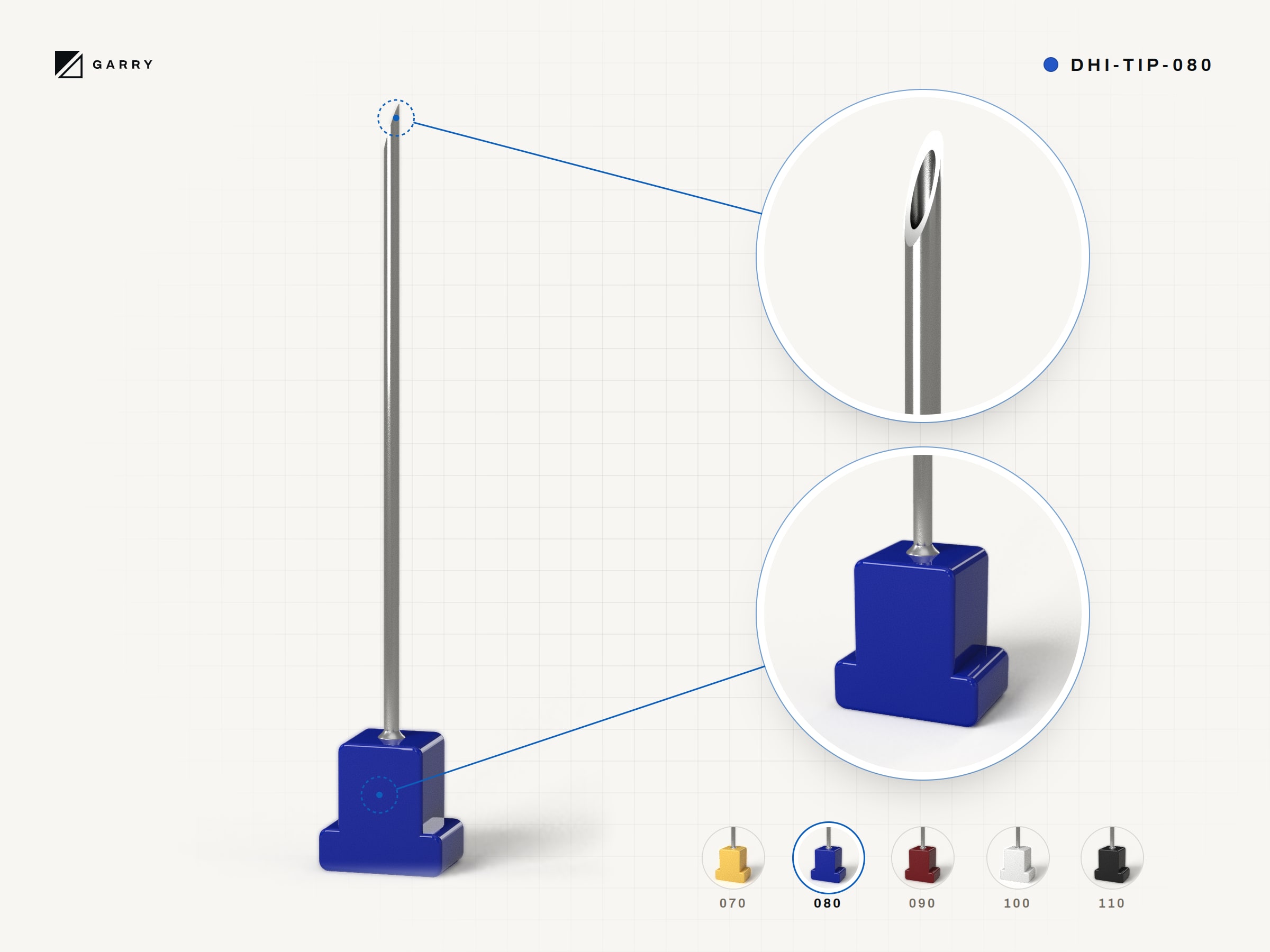
The needle is the wear part. The Garry DHI Implanter Needle is reusable and designed for up to 15,000 penetrations before the tip dulls, and use and reprocessing both wear the tip, so a needle that shows any damage, or that no longer seats firmly, is replaced at once with a new one of the same order code. Garry does not re-sharpen or refurbish needles. Planning needle stock from graft counts, with that design figure in mind, keeps a long session from running short of a size.
Questions clinics ask about DHI instruments
Is DHI a different extraction technique from FUE? No. Grafts are extracted with an FUE punch in both workflows. DHI changes the placement stage only, where an implanter pen replaces pre-made channels and forceps.
Does a DHI pen come with its needle? The Garry pen and needle are separate products with their own order codes, so a quotation lists both, DHI-PEN codes for the pens and DHI-TIP codes for the needles in the same size and colour. What each quoted line includes is stated on the quotation.
Can needles from other brands be used in the Garry pen? Fit of other needles is confirmed on the quotation, not assumed, because implanter needles seat in a specific pen system. The Garry needle is made for the Garry pen.
How many pens does a DHI team need? It depends on team size, graft volume and the sizes in the plan. Send your team size and graft mix with a quote request and we suggest a set of order codes.
Where can I read every question on the pen and needle? The DHI Implanter Pen questions and the DHI needle questions answer them one by one, from sizes to reprocessing.
Equipping a clinic for DHI
Starting DHI is mostly a planning exercise. Decide the punch diameters for your donor profile, map the graft calibers they produce, choose the 2 or 3 pen and needle sizes that seat them, and size the pen rotation to your team. The DHI Implanter Needle page lists every needle by its code, and each size has its own product page, for example the Garry DHI Implanter Pen 0.9 mm.
When you are ready, request a quote with your team size, graft mix and the order codes you are considering. Every quotation is answered in writing within 24 hours on business days, by the team that makes the instruments in Türkiye, and distributors who want to carry the line can apply for a dealer account.